Showing posts with label Inny valley. Show all posts

Sunday, 22 August 2010

fruits of the meadow


blackberries (plus flies) rose hips, bird's foot trefoil, knapweed all in a great tangle of signs and semiotics (see link)

Sunday, 15 August 2010

more meadow pleasures 5

the common blues have found each other,


and the red admiral is only included to show the beautiful contrast of colours

Sunday, 8 August 2010

more meadow pleasures 3 - Cornish fruit flies


and a brilliant small tortoiseshell (bottom), a wall brown (middle) nowhere near a wall but unusually still for this restless butterfly, and an odd shaped fly with a dog on its back (top).

10 August 2010

Thanks to my friends at Wild about Britain, this fly has been identified as chaetorellia jaceae, a fruit fly that lives on knapweed and related species and is used in other parts of the world as a form of biological control for these plant species where they have become invasive. As a group these flies have very elabotrate mating rituals, and often these sorts of colours to act as bayesian mimicry to put off their predators.

later on 10 August 2010

or is it Chaetostomella cylindrica ? This is the definitive fly for a dog's blog.

more meadow pleasures


the knapweed is out and makes a tangled carpet of purple interspersed with tall bunches of fragrant meadowsweet, red sorrel, and the brilliant yellow of bird's foot trefoil. All of these plants act as host to a wide range of insects and the meadows are full of a vast number of them, butterflies, moths, bees, hover flies, grasshoppers,crickets,all busily fuelling up for the serious business ahead.

Saturday, 31 July 2010

,

Small copper butterfly from the side (above) and a crowd of different folk (including a small copper as more usually seen) enjoying some yarrow. Are we in danger of becoming a bug blog? Cassie (Spot's dam) has suffered a major injury to one of her hind legs and her leg has swollen up like a barrel (apparently, so our vet David Ellis says, this is something that happens to greyhound lurcher people) but she has been grounded for a few days and thus we are not going for long walks. It brings to mind that she is 11 years old now and showing some signs of age. What will we do without her?

Thursday, 29 July 2010

in the teeth of a dragonfly


it is usually very difficult to get up this close to a resting dragonfly, but this golden ringed dragonfly seemed happy to pose for posterity.

Sunday, 25 July 2010

more from the meadows


throughout the meadows were these webs which look like little strips of polythene wrapped around the heads of knapweed. I think they contain the young of the spider in the bottom photo, but I cannot identify the species from this photo (and trawling through the field guide to spiders is not for the faint hearted)

butterfly counting


It was British butterfly counting day today, so we went to our favourite meadow and walked through it for 15 minutes. The brambles have almost finished flowering, but the meadow is full of knapweed and in a few days will be a blaze of purple. Like last Sunday we saw many species, including three that were absent last week, the common blue, the peacock (top photo, very resplendent indeed), and the holly blue (bottom photo).This is only the second time in 5 years that we have seen and photographed a holly blue. There were ringlets, various whites and meadow browns beyond count, and a dozen large silver washed fritillaries.

Sunday, 11 July 2010

more purple and orange


today we saw 14 species of butterfly in one meadow :- ringlet, meadow brown, small heath, speckled wood, large white, marbled white, small white, comma (lots of them) silver washed fritillary, red admiral, small tortoiseshell, small skipper, small copper, and gatekeeper; admittedly all quite common but nevertheless that is about 1 in 5 of all our native species (and no blues). The photo above is of the very attractive small copper, and the photo below is of yet another purple flowering plant (less common than some of the others).

Thursday, 8 July 2010

more butterflies


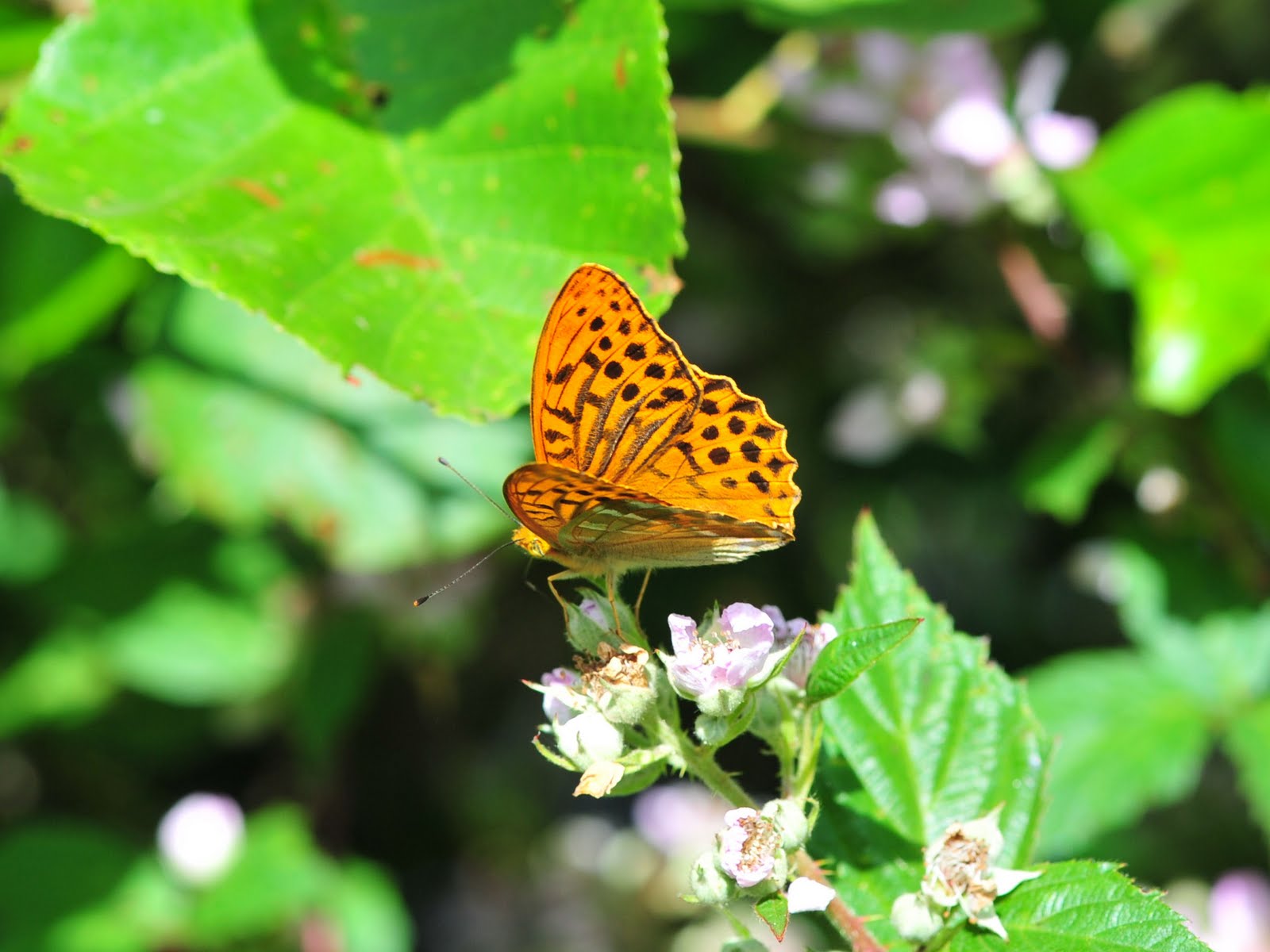
at long last there are signs that the butterflies are returning. At the top are two gate keepers fighting/and or mating. Below are two photos of one of my local favourites the silver washed fritillary,(a male showing the 4 androconial lines of the fore-wings). These are big powerful fliers that fly on the edges of woods and love brambles.
. .


At the bottom is the comma, possibly the second generation this year, and suddenly there are a lot of them. And the meadows were full of ringlets and meadow browns. A lovely day for the amateur lepidopterist.

.

meadow dogs


lounging around in a meadow full of bird's foot trefoil, stitchwort and bedstraw

Monday, 28 June 2010

spot goes fishing


Spot was fascinated by the streaks of marble in the bed of the Inny and after trying to paw them decided to try and fish them out. They are very obvious now because the river is very low, and the sun was very bright. He did not catch the brown trout below, which itself seems to have forgotten about camouflage only working against the right background.

ringlets


Yet again we saw very few butteflies, well we saw lots of meadow browns and ringlets (see photo) but almost nothing else despite the warm sun and lack of wind. Where are they all?

heath bedstraw and stitchwort


the meadows by the Inny are covered, unusually, in white flowers mainly clumps of heath bedstraw and lesser stitchwort, a very delicate version of the larger greater stitchwort. The meadow had a lovely smell of honey and lemons, although my main reference book states that heath bedstraw has a sickly smell. Not true! It is amazing how these meadows change year on year and how different species flourish or struggle. A few years ago the same meadow at this time was a blaze of yellow due to bird's foot trefoil, and last year it was full of ragged robin. It is gradually becoming covered in bramble and reeds.
. !

Wednesday, 2 June 2010

dragonflies and robins


the top two pictures are close ups of the a female dragonfly (broad bodied libellula) which is quite common around here but always impressive when you see one. The bottom picture is of some ragged robin and visitor. Usually there is a lot of ragged robin in the marshy meadows by the Inny, but this year it is very sparse.

Sunday, 23 May 2010

black legs, bluebells and trout

It has been very warm weather this weekend and the bluebells in our woods are at their peak. And, for the very first time we have actually managed to photograph a brown trout in the Inny.
.
Waiting for one of these (a demoiselle or blue agrion) to land on its head.


.

Sunday, 9 May 2010

bluebells and ramsons


as promised everything is flowering at once this year. The woodland floor is covered with bluebells, ramsons (our wild garlic) and wood anemones, mixed up with stitchwort, and toothwort, and yellow archangel and everything else. The butterfly feeding on the ramson is a male green veined white, in fact the 'green' is a mixture of yellow and black scales. This is the first of two generations that will fly during the year, and it tends to be darker than the later generation presumably reflecting changes in the foliage

Wednesday, 14 April 2010

Inny foot

Spot at the point where the river Inny enters the Tamar, wondering why it is called Inny foot, and whether this is a good example of having one's foot in one's mouth. And below, it was a long way home.


Monday, 12 April 2010

on the forest floor


wood anemones and daffodils, and a few celandines, flowering in profusion on the floor of ancient woodlands.

Sunday, 4 April 2010

Easter Sunday


the Easter bunny hunt over, Harriet catches her breath amongst our native daffodils, and wishes everyone a Happy Easter. Meanwhile the purple toothwort is taking over the world.