Showing posts with label flora. Show all posts

Sunday, 3 October 2010

autumnal images


sloes, sweet chestnuts, and I am not sure what. possibly wrinked club, but all are redolent of autumn

Sunday, 12 September 2010

on the forest floor


this pretty little flower is trailing St John's wort, one of 13 different species of this perennial (hypericum) which range in size from the very small as here to the Rose of Sharon. On close up you can see the little black glands along the edge of the petal which contain various oily compounds including the compounds responsible for its antidepressant properties.

Sunday, 5 September 2010

goldenrod


It is not Autumn yet but the countryside is beginning to show signs of the end of summer. Puffballs are appearing, and goldenrod is flowering in fields of scabious. And our martins have still not fledged ...they are cutting it very fine if they are going to build up enough fat reserves to fly to Africa.

Sunday, 29 August 2010

autumn is coming


the berries of guelder rose are a brilliant and eye catching red, which is why only a few are left on the bush

on a bed of angelica


a 14 spot ladybird (very small, less than 5mm long and therefore not one of the dreaded variations of the harlequin ladybird) foraging in the seed head of angelica, the flowers of which are very popular with a range of flying bugs (see below)


Sunday, 22 August 2010

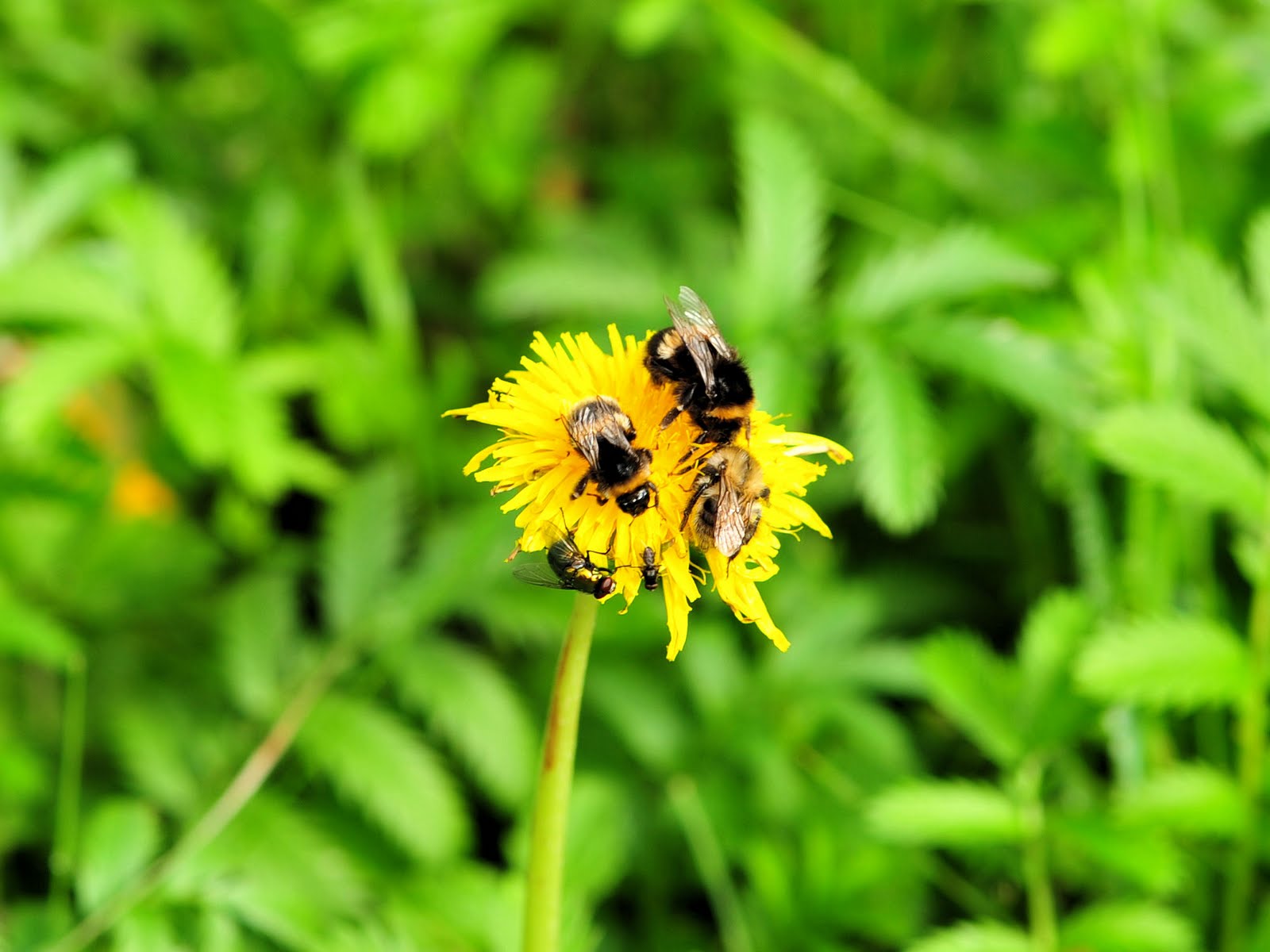
very beesy dandelion


in a meadow full of flowers it is puzzling to see so many bees on a solitary dandelion. There must be something very special about dandelion nectar.

Tuesday, 17 August 2010

summer colours


as the summer draws on more and more of our wild flower seed mix is coming into flower, and with the flowers come a wide range of insects, some too small even for macro photography and I am not buying a microscope for Spot (most useful to find his brain I suspect)

Thursday, 12 August 2010

crab spider


a crab spider (Misumena vatia) not very well disguised on some buddleia, waiting for some unsuspecting bee or butterfly to land. Apparently they can change colour at will, and are usually yellow and live on goldenrod. This one seems to have got it wrong.

Sunday, 8 August 2010

more meadow pleasures 2


he insects included these common blues (male and female) on meadowsweet, and a red admiral on knapweed

more meadow pleasures


the knapweed is out and makes a tangled carpet of purple interspersed with tall bunches of fragrant meadowsweet, red sorrel, and the brilliant yellow of bird's foot trefoil. All of these plants act as host to a wide range of insects and the meadows are full of a vast number of them, butterflies, moths, bees, hover flies, grasshoppers,crickets,all busily fuelling up for the serious business ahead.

Sunday, 25 July 2010

butterfly counting


It was British butterfly counting day today, so we went to our favourite meadow and walked through it for 15 minutes. The brambles have almost finished flowering, but the meadow is full of knapweed and in a few days will be a blaze of purple. Like last Sunday we saw many species, including three that were absent last week, the common blue, the peacock (top photo, very resplendent indeed), and the holly blue (bottom photo).This is only the second time in 5 years that we have seen and photographed a holly blue. There were ringlets, various whites and meadow browns beyond count, and a dozen large silver washed fritillaries.

Sunday, 11 July 2010

more purple and orange


today we saw 14 species of butterfly in one meadow :- ringlet, meadow brown, small heath, speckled wood, large white, marbled white, small white, comma (lots of them) silver washed fritillary, red admiral, small tortoiseshell, small skipper, small copper, and gatekeeper; admittedly all quite common but nevertheless that is about 1 in 5 of all our native species (and no blues). The photo above is of the very attractive small copper, and the photo below is of yet another purple flowering plant (less common than some of the others).

Friday, 9 July 2010

purple patches 2


and these

purple patches 1


we have noticed that as it moves towards mid summer and later there are more and more wild flowers in the blue mauve purple part of the spectrum. There are of course still lots of plants that flower in yellow and white but is there something that favours the UV end of the spectrum at this time of year? Maximum marks to anyone who can name all of the wild flowers in these two posts that we came across on our walk yesterday.

Thursday, 8 July 2010

meadow dogs


lounging around in a meadow full of bird's foot trefoil, stitchwort and bedstraw

Saturday, 3 July 2010

we all live in a yellow ...


the creamy yellow flowers of our native honeysuckle are bursting through the upper layers of the hedgerows, and above them a yellow hammer is singing his heart out.

Monday, 28 June 2010

spot goes fishing


Spot was fascinated by the streaks of marble in the bed of the Inny and after trying to paw them decided to try and fish them out. They are very obvious now because the river is very low, and the sun was very bright. He did not catch the brown trout below, which itself seems to have forgotten about camouflage only working against the right background.

heath bedstraw and stitchwort


the meadows by the Inny are covered, unusually, in white flowers mainly clumps of heath bedstraw and lesser stitchwort, a very delicate version of the larger greater stitchwort. The meadow had a lovely smell of honey and lemons, although my main reference book states that heath bedstraw has a sickly smell. Not true! It is amazing how these meadows change year on year and how different species flourish or struggle. A few years ago the same meadow at this time was a blaze of yellow due to bird's foot trefoil, and last year it was full of ragged robin. It is gradually becoming covered in bramble and reeds.
. !

Tuesday, 22 June 2010

a few things we have seen locally 1


Spot doesn't usually spend much time in his garden, but this year the peonies have relished the unusual warmth and this is his all time favourite.

And even more exciting is this insignificant looking little flower. It is the first time our english walnut has flowered since it was planted on Good Friday, 1999. Reliable sources report that walnuts do not mature for 10 years or so. They self pollinate, so maybe we will be eating our own walnuts at the end of the year...just like France.

Wednesday, 2 June 2010

dragonflies and robins


the top two pictures are close ups of the a female dragonfly (broad bodied libellula) which is quite common around here but always impressive when you see one. The bottom picture is of some ragged robin and visitor. Usually there is a lot of ragged robin in the marshy meadows by the Inny, but this year it is very sparse.